
ZeroClaw vs OpenClaw: Detailed Comparison (Latest Feb 2026)
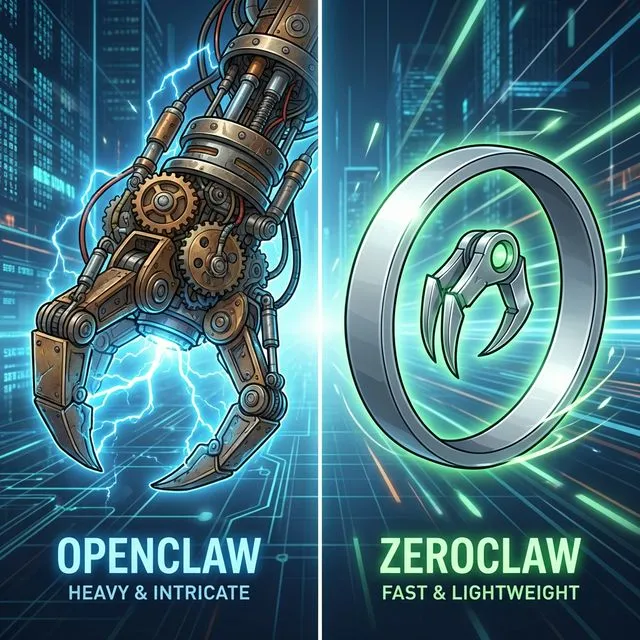
ZeroClaw and OpenClaw are both open-source local AI Agent / Personal AI Assistant frameworks that can connect to LLMs, support tool calling, respond in real-time on messaging channels like WhatsApp/Telegram, and execute real tasks (like sending emails, managing calendars, and automating workflows).
OpenClaw is the original version (formerly Clawdbot / Moltbot) that exploded in popularity early 2026; ZeroClaw is a lightweight alternative completely rewritten in Rust, specifically addressing OpenClaw's pain point of being "too heavy and resource-intensive". The two are highly compatible (ZeroClaw supports direct migration of OpenClaw's configuration and memory data).
1. Core Comparison at a Glance
| Feature | OpenClaw | ZeroClaw | Winner |
|---|---|---|---|
| Language/Architecture | Node.js + TypeScript (some Swift) | Pure Rust (Single executable binary) | ZeroClaw (More modern) |
| Binary Size | ~28MB+ (incl. node_modules) | 3.4 MB | ZeroClaw (8x+ smaller) |
| Memory Usage | >1 GB (Peaks can reach several GBs) | <5 MB (99% less) | ZeroClaw (Overwhelming win) |
| Startup Time | Hundreds of ms ~ several seconds (Node process startup) | <10 ms (Even on 0.6GHz old hardware <1s) | ZeroClaw (50-400x faster) |
| Power/Hardware Cost | Requires Mac Mini or high-end server | $10 hardware (Raspberry Pi Zero, cheap SBCs, embedded) | ZeroClaw (98% cheaper) |
| Security Defaults | Powerful but higher risk (needs manual hardening) | More restrictive + allowlist + smaller attack surface | ZeroClaw |
| Messaging Channels Supported | Extremely rich (WhatsApp, Telegram, Discord, Slack, iMessage, Signal, Teams, etc.) | Broad coverage (Plugin-based, supports migration) | OpenClaw slightly wins |
| Functional Positioning | Full-stack personal/team assistant + rich ecosystem | Ultra-efficient Agent runtime + plugins | Tie (Depends on needs) |
| Community & Maturity | Massive (Hundreds of thousands of Stars, active Discord) | Emerging but growing extremely fast (Rust community + migration friendly) | OpenClaw |
| Installation/Deployment | pnpm / Docker / One-click script | Single file copy to run | ZeroClaw is simpler |
2. Detailed Dimension Breakdown
Architecture & Tech Stack
- OpenClaw: Traditional long-running service, relies on the Node.js ecosystem, suitable for complex state management and UI (has a web console, iOS/Android companion App).
- ZeroClaw: Rust trait system achieves complete modularity (Provider, Channel, Memory, Tool are all hot-pluggable). After compilation, it's just a single binary, with no runtime dependencies, and memory safety is guaranteed by the compiler.
Performance & Resources (Biggest actual gap)
ZeroClaw officially claims to "do everything OpenClaw can do, but with only 1% of the resources." On low-end hardware, OpenClaw might not run at all or freeze; ZeroClaw can run resident in the background almost unnoticeably.
Features & Ecosystem
- OpenClaw: Out of the box, integrates more channels + a large number of community Skills (700+), has visual workflows, memory enhancement, voice, etc.
- ZeroClaw: Focuses on the core engine + plugin ecosystem, already supports 22+ LLM Providers (OpenAI, Anthropic, local models, etc.), memory system supports hybrid vector + full-text search + optional PostgreSQL.
- Super Simple Migration: Directly reads OpenClaw's config and memory data.
Security
- OpenClaw: Powerful features but default permissions are broad (file, shell, browser automation, etc.), requiring careful configuration.
- ZeroClaw: Defaults are more conservative (allowlist, authentication pairing), attack surface is much smaller, more suitable for production or sensitive environments.
Recommended Scenarios
Choose OpenClaw:
- You have powerful hardware (Mac / High-end server / Cloud VPS)
- You want the richest out-of-the-box channels and community Skills
- You're looking for the "full suite" experience (Web Dashboard + Mobile App)
Choose ZeroClaw (Currently more recommended for most people):
- Hardware is limited or you want to save money (Raspberry Pi, old PC, edge devices)
- Needs 24/7 background residency, low power consumption, low cost deployment
- Values security and ultimate performance (Production environments, embedded, smart home)
- Already using OpenClaw and want to reduce resource consumption (direct migration)
3. Pros and Cons Summary
OpenClaw
- Pros: Most comprehensive features, most mature ecosystem, most active community
- Cons: Resource-hungry, slow startup, slightly heavy deployment, security needs extra attention
ZeroClaw
- Pros: Extremely lightweight, lightning-fast startup, ultra-low cost, better security defaults, cross-platform single file
- Cons: As a new project, some advanced Skills and UI ecosystem are still catching up rapidly (but many can be reused after migration)
4. How to Get It (Latest Feb 2026)
- OpenClaw: Official Site | GitHub | Docs
- ZeroClaw: Comparison Page | GitHub
To install ZeroClaw, usually you just need to download a single binary + the zeroclaw onboard 1-click wizard.
Conclusion
If we compare OpenClaw to a "fully-featured luxury sedan," ZeroClaw is the "ultra-efficient electric race car"—getting to the same destination, but ZeroClaw is more fuel-efficient, faster, and safer.
Current community feedback (late Feb 2026): Many heavy users have switched from OpenClaw to ZeroClaw, resource usage dropped directly from GB levels to MB levels, and the experience has "taken off." It is highly recommended to try ZeroClaw first (unless you specifically need some of OpenClaw's exclusive advanced Skills). Both are free and open-source, so we recommend installing both to compare—the migration cost is almost zero.