
The OpenClaw Crisis: Over 220,000 AI Agents Exposed Without Protection
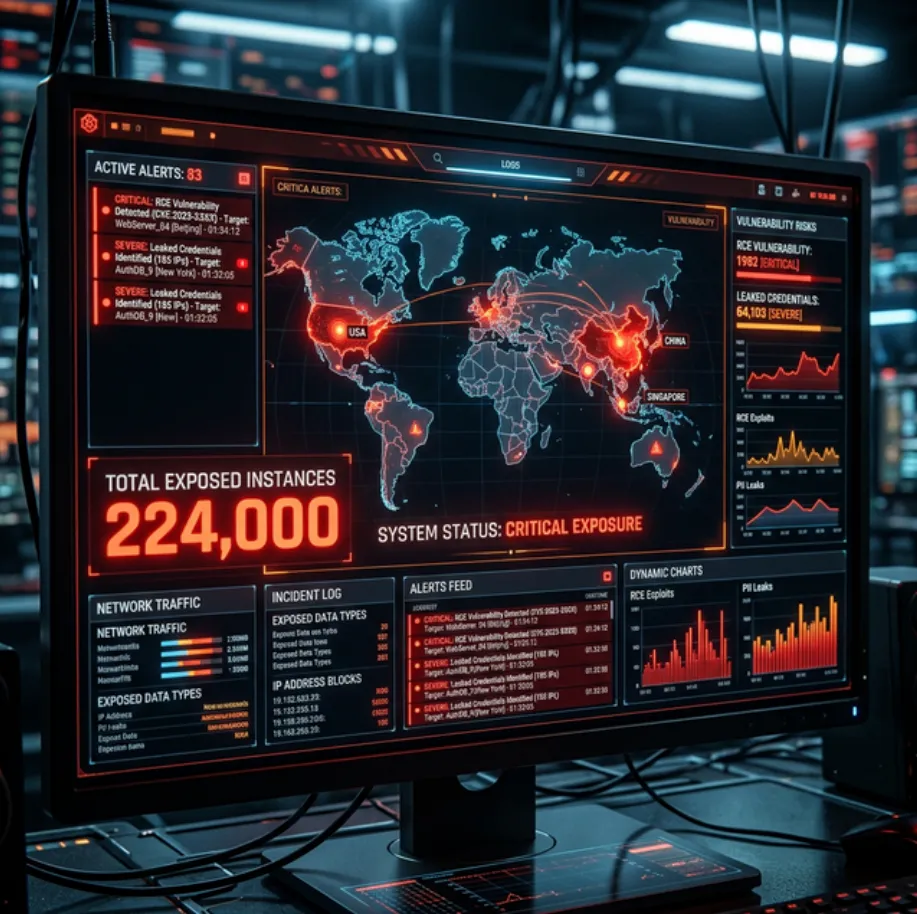
Yes, the news is entirely true, and the situation is even more critical than anticipated—currently, there are over 224,000 exposed OpenClaw Agent instances on the public internet!
Based on real-time monitoring data (as of March 2, 2026):
🚨 The State of the Crisis: A Massive Scale Exposure
Two primary monitoring dashboards highlight the severity:
-
OpenClaw Exposure Watchboard (Official defensive monitor):
- Main Page:
- Active Exposed Instances:
224,015 - Shockingly, sampling shows: About 30% of instances have no authentication enabled, and nearly 60% indicate leaked credentials or API Keys!
-
DECLAWED Dashboard (by Team STRIKE, ):
- Found a staggering total of
362,342footprinted instances. - Critical Risk: 28.4% of active instances contain Remote Code Execution (RCE) vulnerabilities.
- Geography: Cloud servers in China (96.9K), USA (58.7K), and Singapore (29.3K) top the list.
- Most are hosted on mainstream cloud providers like Alibaba Cloud, Tencent Cloud, AWS, Oracle, etc.
- Found a staggering total of
⚠️ Why is Agent Exposure Worse than Standard Web Ports?
OpenClaw is not a static webpage; it is an autonomous agent with a complete toolchain. These agents can execute code, read/write files, manipulate databases, and even interact via email or messaging APIs.
If hijacked, attackers can:
- Directly remote-control your business systems.
- Steal all associated high-value enterprise credentials.
- Turn your powerful cloud instances into botnet nodes.
- Exploit malicious plugins easily accessible via the ClawHub marketplace.
This is a massive production incident reflecting the dangers of "Shadow IT + The Agent Era." Numerous enterprises, including Meta, have already internally banned running OpenClaw on work devices.
🛡️ Emergency Action Guide: Secure Your Agent
If you are using or planning to use OpenClaw, take these steps immediately:
- Check Your Footprint: Search for your IP/Port/ASN on the mentioned dashboards.
- Close Public Access: Stop exposing the port to the public internet immediately. Bind to
localhostand use secure tunnels like Cloudflare Tunnel, Tailscale, or Ngrok. - Enforce Auth: Force strong authentication and immediately rotate all API Keys.
- Isolate: Run the Agent in tightly isolated containers (Docker) or VMs, ensuring the Principle of Least Privilege for all agent skills.
- Patch: Update to the latest version to patch all known RCE CVEs.
Let us know if you need specific security configurations for Docker/VPS or targeted ASN analysis. It's time to realize that with great computational power comes the need for uncompromised security.